|
|
A Meditating Romantic
Painter Hovik Muradian was born in 1964 in Yerevan, Armenia, within the view of the biblical Mt. Ararat, in the land of the sun, mountains, rocks, and savanna grass, in the country with a fate similar to that of every small country controlled by a more powerful country, in the country with the history of struggle for independence. Back in 1964, Armenia was a part of the Soviet Union and was called the Armenian Socialist Republic.
After the tragic earthquake in 1988, Hovik went on a quest for a new life outside his homeland. He found it in the Czech Republic where he has been living since 1992.
He has a nice family and a studio close to his flat in one of the Prague suburbs where he paints, and he exhibits his paintings around the world. Yet, his dark eyes keep looking through the web of nostalgia, his blood is diluted with meditation, and his romantic heart searches for angular colors of brightness. But I may be totally wrong. I am just trying to find an alibi for my headline.
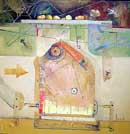
Hovik Muradian was raised in a family where his father, academic painter Shavarsh Muradian (1936), whose favorite style of painting was landscape, initiated Hovik’s artistic education (the School of Arts of Jakob Kojoian, and the College of Arts of Panos Terlemezian in Yerevan from 1976 to 1984). Cultural inspiration, music, theatre, literature etc. are probably the legacy of the school; we can find symbols of the mentioned arts both in his early and later paintings. However, what the painter soon left behind was the technique of paint applying. His impasto paintings quickly changed into delicately color and delimited areas. The delimitation of shapes is a typical element in Muradian’s paintings. Sometimes, the area is geometrically divided into right-angle shapes, other times the painter seems to use different arches to make them in an abstract grouping of matter. However, he never stops there. In his compositions, we can find a part of a figure, nude, musical instrument, or common item. His genre is figurative abstraction. Rationality that forces us to meditate can be found only in his later paintings. His canvases are full of technical artifacts symbolizing time, order, as well as mystery, a pursuit to learn, search, and ask questions. His paintings clearly show what kind of questions the author asks.
He loves to paint in the Armenian style. A bright sun, summer weather, joyful and bright colors, and nostalgic citations in his mother tongue (e.g. “The swallow is building its nest, is building and singing, and with each twig it adds on, it thinks of its old nest…”) are typical evidence that the author is from the East.
I do not know if it is the seeing of the world from below the biblical Mt. Ararat that gives Hovik an archetypal urge for the existence of the beginning or if his Noah and scene of paradise are just a mere calculation, yet the mentioned motifs cannot be overlooked in his work. It is not just the exterior; the position and gestures of the figures refer to the spiritual dimension of the message. Even the look of the animals bears the specific Muradian characteristics.
The paintings of Hovik Muradian are not aggressive, they are to pacify as they pacify their author. They are to appease as they appease their author. This theory is supported the best by women in his paintings, who are gentle, often with their head turned away and an unreadable face. However, if the author paints a nude, we can see sophistication and composure, which one would not expect from the forty-year-old artist. Art lovers are lucky that Hovik Muradian has enriched our world of painting. He has thus enriched us all.
Petr Cincibuch
Hovik Muradian paintings, prints and sculptures, protected by copyright, Act No. 121/2000 Coll.
|
|
|
|